5 AI Use Cases Every Sales Team Should Implement
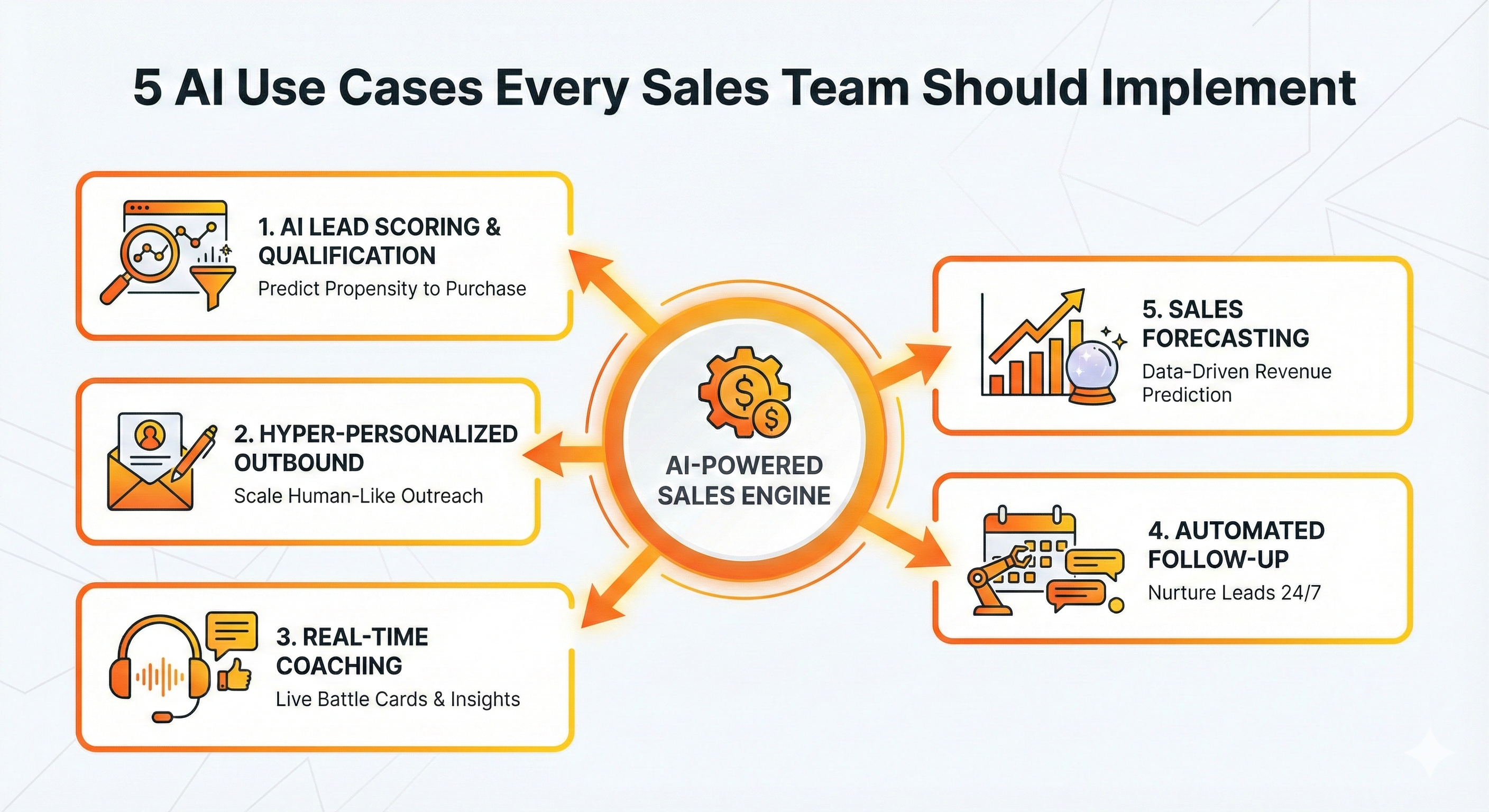
In the traditional sales world, the "top of the funnel" is often a numbers game—a grueling marathon of cold calls, manual lead scraping, and repetitive follow-ups. For many sales development representatives (SDRs), as much as 60% of their day is spent on administrative tasks rather than actually selling.
AI is changing that equation. It isn't just about "replacing" salespeople; it's about providing them with a digital exoskeleton that amplifies their intuition and handles the heavy lifting. By implementing these five AI use cases, sales teams can move from "guessing" to "knowing," ensuring they spend their time where it matters most: closing deals.
1. AI-Powered Lead Scoring & Qualification
Not all leads are created equal. Traditionally, teams used static rules to score leads (e.g., "if they are a VP, give them 10 points"). AI lead scoring is dynamic. It analyzes thousands of data points—from website behavior and social media activity to historical CRM data—to identify which prospects are actually ready to buy.
By predicting the "propensity to purchase," AI ensures that your high-value account executives are only talking to prospects who have a high likelihood of converting, drastically reducing the sales cycle length.
2. Hyper-Personalized Outbound at Scale
The era of the "spray and pray" email template is over. Prospects can smell a generic automated email from a mile away. However, manually researching every prospect takes hours.
AI assistants can now browse a prospect's LinkedIn profile, recent company news, and financial reports to draft a hyper-personalized opening line in seconds. This allows a single salesperson to send hundreds of personalized emails that feel like they were written after an hour of research, maintaining the "human touch" without the human time investment.
3. Real-Time Sales Coaching (Conversation Intelligence)
What happens during a sales call is often a "black box" for managers. Conversation intelligence tools use AI to transcribe calls in real-time, analyzing the "talk-to-listen ratio," sentiment, and how often competitors are mentioned.
More importantly, AI can provide live "battle cards" on the salesperson's screen. If a prospect brings up a specific technical objection or mentions a competitor, the AI instantly pulls up the best rebuttal or feature comparison, acting as a silent, expert coach during the live negotiation.
4. Automated Follow-Up and Nurturing
The fortune is in the follow-up, yet most leads are dropped after just two or three attempts. AI-driven "nurture bots" can handle the persistent, multi-channel follow-up required to get a response.
These bots don't just send reminders; they can answer basic technical questions, handle scheduling via your calendar, and only "hand off" the conversation to a human rep once the prospect has expressed a clear intent to book a meeting. This ensures that no lead ever falls through the cracks due to a busy schedule.
5. Sales Forecasting & Pipeline Health
Most sales forecasts are based on "gut feeling" or overly optimistic projections from reps. AI brings cold, hard data to the forecast. By looking at historical patterns—how long deals usually sit in the "Discovery" phase or how often a certain stakeholder's involvement leads to a win—AI can predict your quarterly revenue with startling accuracy.
It can also flag "at-risk" deals. If a deal that usually takes 10 days to move from "Proposal" to "Contract" has been sitting for 20 days, the AI alerts the manager to intervene before the deal goes cold.
The AI Sales Stack: Where to Start?
To maximize the impact of AI in your sales process, it's important to understand how these tools integrate into your current workflow. Think of your sales funnel through an automated lens:
- Top of Funnel (Prospecting): AI lead scoring identifies high-intent prospects from your inbound traffic and outbound campaigns.
- Middle of Funnel (Engagement): Hyper-personalized outreach and automated nurturing keep prospects warm while your team focuses on qualified opportunities.
- Bottom of Funnel (Closing): Real-time conversation intelligence and accurate forecasting help you close deals faster and with higher confidence.
Conclusion
Implementing AI in sales isn't about working harder; it's about working smarter. By automating the "grunt work" of prospecting, qualification, and administrative follow-up, you empower your sales team to do what they are best at: building relationships and solving customer problems.
The sales teams that embrace AI today will be the ones dominating their markets tomorrow. The question isn't whether you should adopt AI—it's how quickly you can implement it before your competitors do.
Supercharge Your Sales Team with AI
Join Stage5 and start automating your sales workflows. Qualify leads faster, personalize outreach at scale, and close more deals.
Start Free BetaNadav Yeheskel
Co-founder & COO, Stage5
Nadav is passionate about democratizing AI and helping businesses automate workflows without code.