The No-Code Revolution: Building AI Without Developers
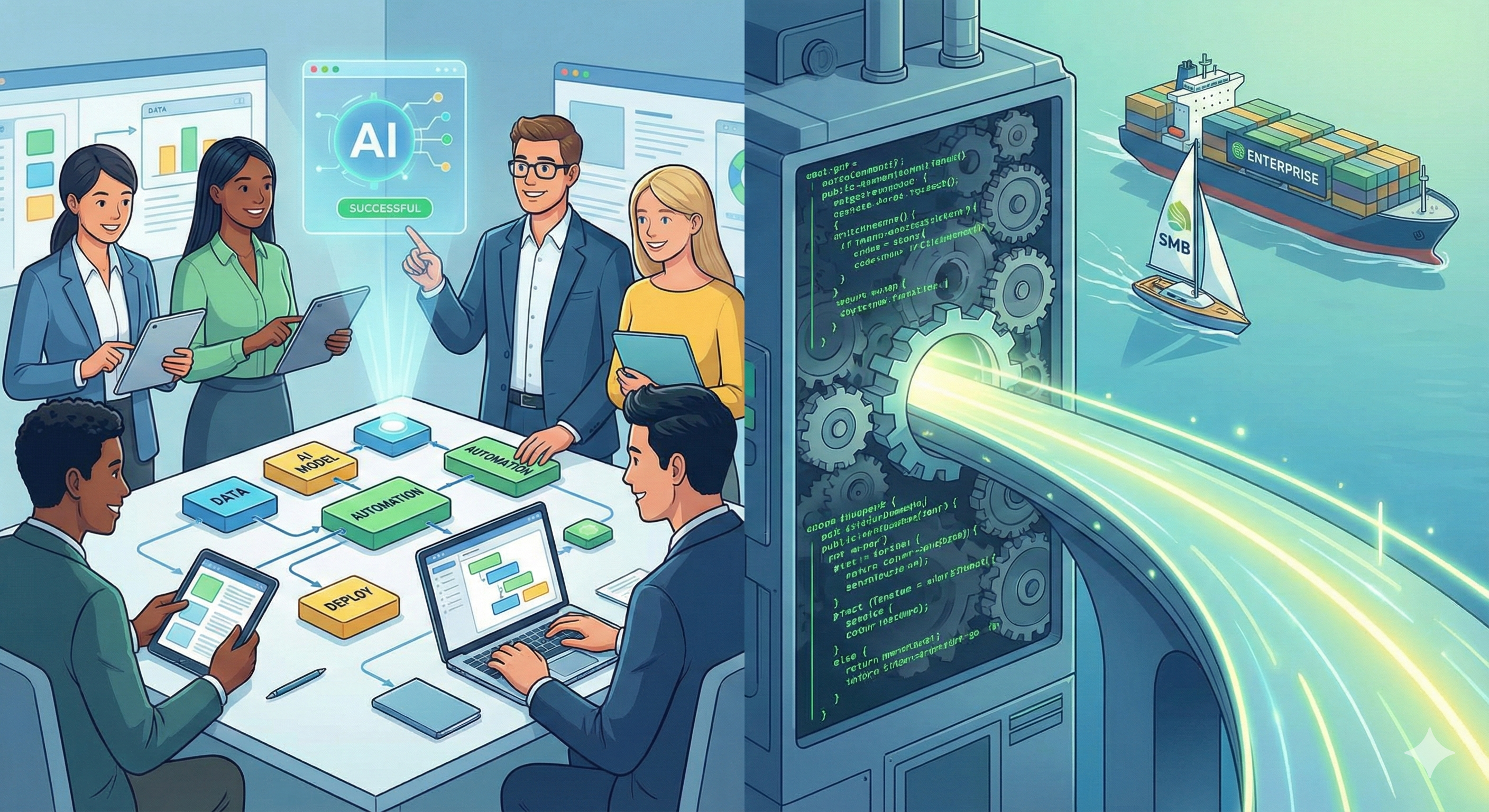
For the past decade, the narrative around Artificial Intelligence has been dominated by a single, formidable barrier: the talent gap. The promise of AI—predictive insights, autonomous workflows, hyper-personalization—was tantalizing, but execution required phalanxes of data scientists, machine learning engineers, and expensive infrastructure.
AI was an exclusive club, and entry fees were exorbitant. As a result, enterprise giants with bottomless R&D budgets pulled ahead, while Small and Medium-sized Businesses (SMBs) watched from the sidelines, unable to compete with the technological arms race.
That narrative is rapidly collapsing. We are entering the era of the "No-Code Revolution," a seismic shift in software development that is democratizing access to powerful technology. By abstracting away complex programming languages behind visual interfaces, no-code platforms are allowing business users, domain experts, and product managers to build sophisticated AI applications without writing a single line of Python or C++.
Here is how the no-code revolution is rewriting the rules of business automation and leveling the playing field for SMBs.
Deconstructing the "Black Box"
Traditionally, building an AI application involved a complex pipeline: collecting and cleaning massive datasets, selecting the right algorithms, training models, tuning hyperparameters, and then deploying that model into production infrastructure. Every step required specialized, highly technical knowledge.
No-code AI platforms change this dynamic by turning this complex pipeline into pre-built blocks. They offer intuitive, drag-and-drop interfaces where users can connect data sources, select pre-trained models (like GPT-4 for text or various vision models for images), and define the logic of how the AI should behave.
Think of it as the difference between building a car engine from scratch versus configuring a high-performance vehicle using a digital customizer tool. You don't need to know how the combustion cycle works; you just need to know that you want more horsepower and better handling. No-code allows subject matter experts to focus on the outcome, not the underlying syntax.
The Drivers of the Revolution
Why is this shift happening now? A convergence of three factors has created the perfect storm for no-code adoption:
1. The Developer Shortage Crisis
The demand for skilled software engineers and AI specialists vastly outstrips supply. Hiring these roles is expensive, competitive, and time-consuming. For many companies, the backlog of necessary IT projects stretches out for years because there simply aren't enough hands on keyboards to build them. No-code relieves this pressure valve.
2. The Need for Speed
In today's market, agility is the ultimate currency. Waiting six months for an engineering team to Scope, Build, and QA a new internal tool is often six months too long. No-code allows teams to prototype, iterate, and deploy solutions in days or weeks.
3. Model Maturity
The underlying AI models provided by companies like OpenAI, Google, and Anthropic have become incredibly robust and generalized. You no longer need to train a model from scratch to understand sentiment or summarize text; you just need to connect via API to a model that already does it exceptionally well. No-code platforms act as the user-friendly bridge to these powerful APIs.
How SMBs Are Competing with Giants
The most profound impact of no-code AI is the democratization of automation. It is effectively arming SMBs with weapons previously reserved for the enterprise.
When technical barriers fall, domain expertise becomes the most valuable asset. A customer support manager at a mid-sized e-commerce company knows their customers' pain points far better than an external software engineer. With a no-code platform, that manager can build an AI-powered triage system that routes tickets based on sentiment and urgency, automatically resolving tier-one issues.
SMBs are using these platforms to punch above their weight class in several key areas:
- Hyper-Personalized Marketing: Instead of generic email blasts, small marketing teams are using no-code tools to analyze customer behavior and generate personalized content blocks at scale, rivaling the segmentation capabilities of massive corporations.
- Intelligent Operations: Operations teams are building custom workflows that automatically read invoices using OCR (Optical Character Recognition), extract key data points, and feed them into accounting software, eliminating hours of manual data entry.
- Product Enhancement: Product managers are rapidly prototyping AI features—such as in-app summarization or intelligent search—to test user engagement before committing expensive engineering resources to a full build.
The Rise of the "Citizen Developer"
This revolution is giving rise to a new persona within organizations: the "Citizen Developer." These are employees sitting in business functions—marketing, HR, finance, sales—who are using approved no-code platforms to build business-critical applications.
While this unlocks immense potential, it requires a cultural shift. IT departments must transition from being gatekeepers to being enablers. They need to establish governance capabilities, ensure security compliance, and provide guardrails so that citizen developers can build safely without creating a chaotic mess of "shadow IT."
When managed correctly, this fosters a culture of innovation where the people closest to the problem are empowered to build the solution.
The Future is Hybrid
Is code dead? Absolutely not. For highly complex, bespoke, high-performance applications, traditional coding will always be necessary.
However, for the vast majority of business automation needs, no-code is becoming the default. We are moving toward a hybrid future. Professional developers will focus on building the core infrastructure and the hardest technical challenges, while business users leverage no-code platforms to handle the "last mile" of application development, customizing workflows to fit their specific needs.
The barriers are down. The tools are available. The question for businesses today isn't whether they can afford to build AI; it's whether they can afford not to. The no-code revolution ensures that the best ideas win, regardless of how many developers you have on payroll.
Ready to Build AI Without Code?
Join Stage5 and start building powerful AI assistants in minutes. No developers, no code, just results.
Start Free BetaNadav Yeheskel
Co-founder & COO, Stage5
Nadav is passionate about democratizing AI and helping businesses automate workflows without code.