ROI of AI Automation: A Complete Guide for SMBs
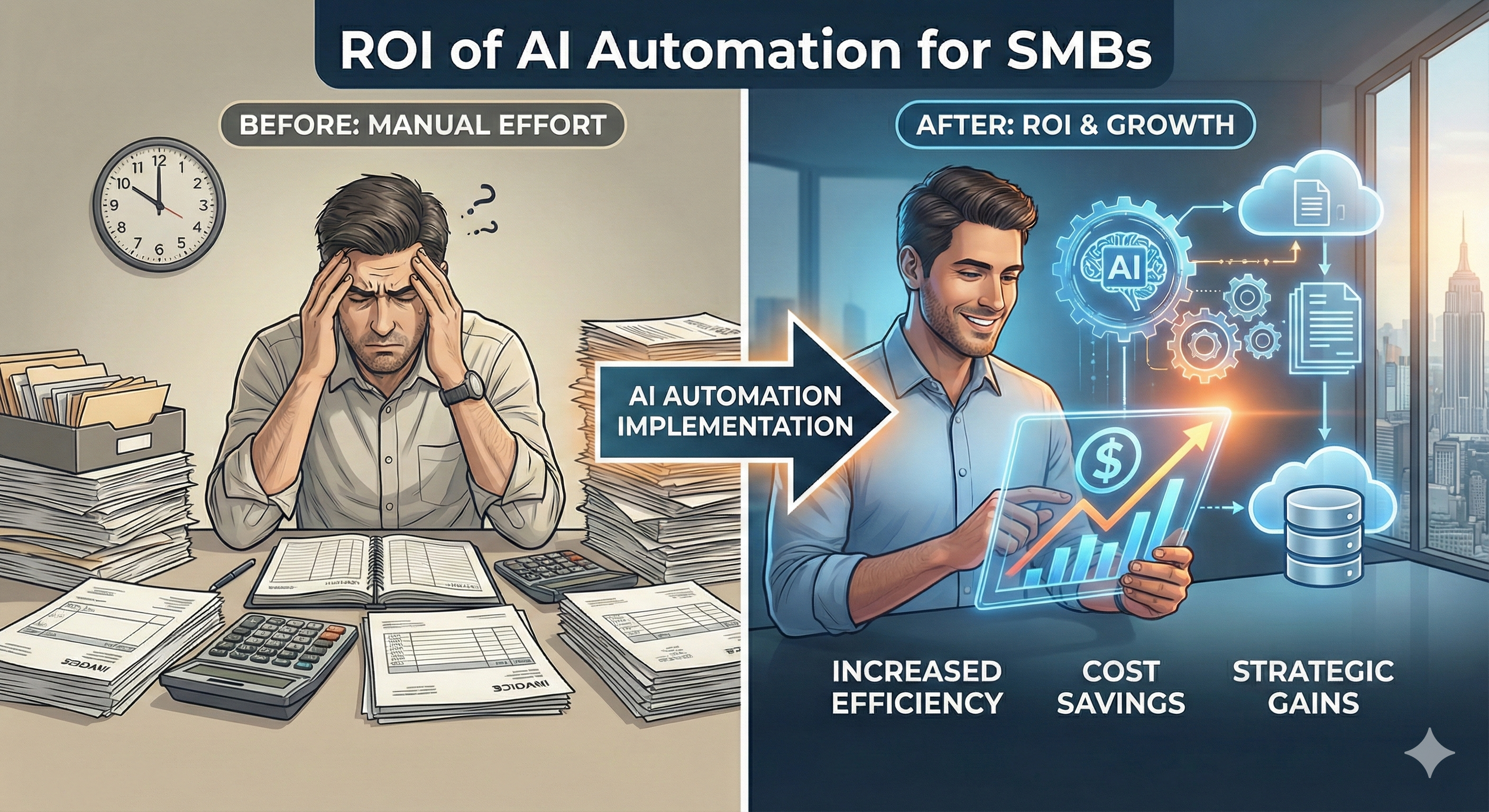
For Small and Medium-sized Businesses (SMBs), the buzz surrounding Artificial Intelligence often feels like a party they aren't invited to. The headlines are dominated by billion-dollar enterprise investments and complex technical jargon. For the average business owner operating on tight margins, the primary question about AI isn't "How does it work?" but rather, "Will it actually make me money?"
Implementing AI automation is not a science experiment; it is a business investment. Like any investment, it requires a clear, calculable Return on Investment (ROI). Without knowing the math, adopting AI is just guessing.
For SMBs, the stakes are high. You don't have money to burn on shelfware. But the risk of inaction is even higher—competitors who successfully leverage AI will operate faster, cheaper, and smarter. This guide will move beyond the hype to provide a practical framework for calculating the real ROI of AI automation in your operations.
The Shift: Why AI ROI is Different Now
Historically, automation required heavy infrastructure and custom coding, pushing the ROI horizon out by years. Today, the "as-a-service" model and no-code platforms have dramatically lowered the barrier to entry.
For SMBs, this means the "Time to Value"—the period between initial investment and realizing benefits—has shrunk from quarters to weeks, or even days. The question has shifted from "Can we afford to build this?" to "How quickly can this subscription pay for itself?"
To understand the full picture, we must break ROI down into two categories: Hard ROI (tangible financial gains) and Soft ROI (strategic, intangible benefits).
1. Calculating Hard ROI: The Tangible Numbers
Hard ROI is the bedrock of your business case. It is directly measurable and impacts your bottom line immediately. It usually comes in two forms: cost reduction and revenue lift.
The Cost Reduction Formula
The most common starting point for SMB automation is replacing manual, repetitive labor with automated workflows. To calculate this, you need to understand the "fully loaded cost" of a human performing a task versus an AI.
The Basic Formula:
Total Annual Savings = (Hours Saved Per Year × Hourly Cost of Employee) – Total Annual Cost of AI Tool
A Practical Example: Automated Invoice Processing
Let's say your accounts payable clerk spends 15 hours a week manually data-entering invoices into QuickBooks.
- Employee Cost: The clerk earns $30/hour (fully loaded with benefits/taxes).
- Current Annual Cost: 15 hours/week × 52 weeks × $30/hr = $23,400 per year spent on data entry.
- The AI Solution: You implement an AI document processing tool that costs $400 per month ($4,800 annually) and automates 80% of that work.
- The Math: You save 80% of $23,400, which is $18,720 in labor value.
- The Hard ROI: $18,720 (Savings) - $4,800 (Tool Cost) = $13,920 Net Annual Gain.
That is a nearly 3x return on the initial investment in the first year alone.
The Revenue Lift Factor
Hard ROI isn't just about saving money; it's about making more of it. How does automation contribute to top-line growth?
- Increased Sales Capacity: If your sales team spends 40% of their time researching leads and data entry, automating those tasks gives them 40% more time to actually sell. If an average rep closes $500k a year, a 40% increase in selling time could theoretically yield another $200k in revenue without hiring another headcount.
- Faster Lead Response: Studies consistently show that responding to a lead within 5 minutes increases conversion rates dramatically. An AI chatbot that instantly qualifies and books meetings 24/7 captures revenue that would otherwise go to competitors during off-hours.
2. Valuing Soft ROI: The Strategic Gains
Many SMB owners make the mistake of ignoring soft ROI because it's harder to put on a spreadsheet. This is a critical error. Soft ROI often drives long-term sustainability and competitiveness.
Employee Retention and Satisfaction
AI is not about replacing humans; it's about liberating them from "robot work." When you remove drudgery—like copy-pasting data between spreadsheets—job satisfaction rises. In a tight labor market, increasing retention by even 10% saves tens of thousands of dollars in recruiting and retraining costs.
Error Reduction and Compliance
What is the cost of a fat-finger error on a critical quote? What is the cost of a compliance breach because a step was missed in a manual process? Humans get tired and distracted; bots do not. AI ensures consistency, reducing costly errors and liability.
Improved Customer Experience (CX)
Today's customers demand instant gratification. AI provides 24/7 support availability and faster resolution times. While difficult to calculate precisely, improved CX leads to higher Customer Lifetime Value (LTV) and reduced churn. If automation helps you reduce churn by 5%, that compound value over three years is immense.
3. The Reality Check: Total Cost of Ownership (TCO)
To calculate an honest ROI, you must look beyond the monthly subscription fee of the AI tool. You need to calculate the Total Cost of Ownership (TCO).
If you underestimate TCO, your ROI calculation will be wildly optimistic. Be sure to factor in:
- Implementation Costs: Will you need a consultant to set it up? How many internal hours will be needed to configure the workflows?
- Training and Change Management: Your team needs to learn how to use the new tools and, more importantly, trust them. This requires dedicated time.
- Maintenance and Oversight: AI isn't "set it and forget it." Someone needs to monitor performance, handle exceptions, and update workflows as your business changes.
The Adjusted ROI Formula:
ROI % = [(Total Hard & Soft Gains – TCO) / TCO] × 100
4. A Practical Framework for SMBs to Start
Don't try to automate everything at once. A successful AI strategy for SMBs depends on rapid iteration.
Step 1: The "Boring" Audit
Identify the most repetitive, mundane, high-volume tasks in your business. Look for processes requiring structured data handling (invoices, forms, standard emails). These are your highest ROI targets.
Step 2: Run a Low-Cost Pilot
Choose one narrow process. Implement a tool, perhaps using a free trial or a low-tier subscription. Define success metrics before you start (e.g., "reduce ticket response time by 50%").
Step 3: Measure Relentlessly
Track the hours saved, the errors reduced, and the costs incurred during the pilot. This provides the proof of concept needed to invest further.
Step 4: Reinvest the Gains
The goal of ROI isn't just to pocket the savings. The smartest SMBs reinvest the saved labor hours into higher-value activities—strategic planning, creative marketing, or deeper customer relationship building.
Conclusion
For SMBs, AI automation is rapidly transitioning from a competitive advantage to a baseline requirement for survival. By focusing on concrete Hard ROI calculations, acknowledging the immense value of Soft ROI, and being realistic about TCO, you can move past the hype and make data-driven investment decisions. The return is there—you just have to do the math.
Calculate Your ROI with Stage5
Start automating your business operations today and see measurable ROI in weeks, not months. Join our free beta.
Start Free BetaNadav Yeheskel
Co-founder & COO, Stage5
Nadav is passionate about democratizing AI and helping businesses automate workflows without code.