Security Best Practices for AI Implementation
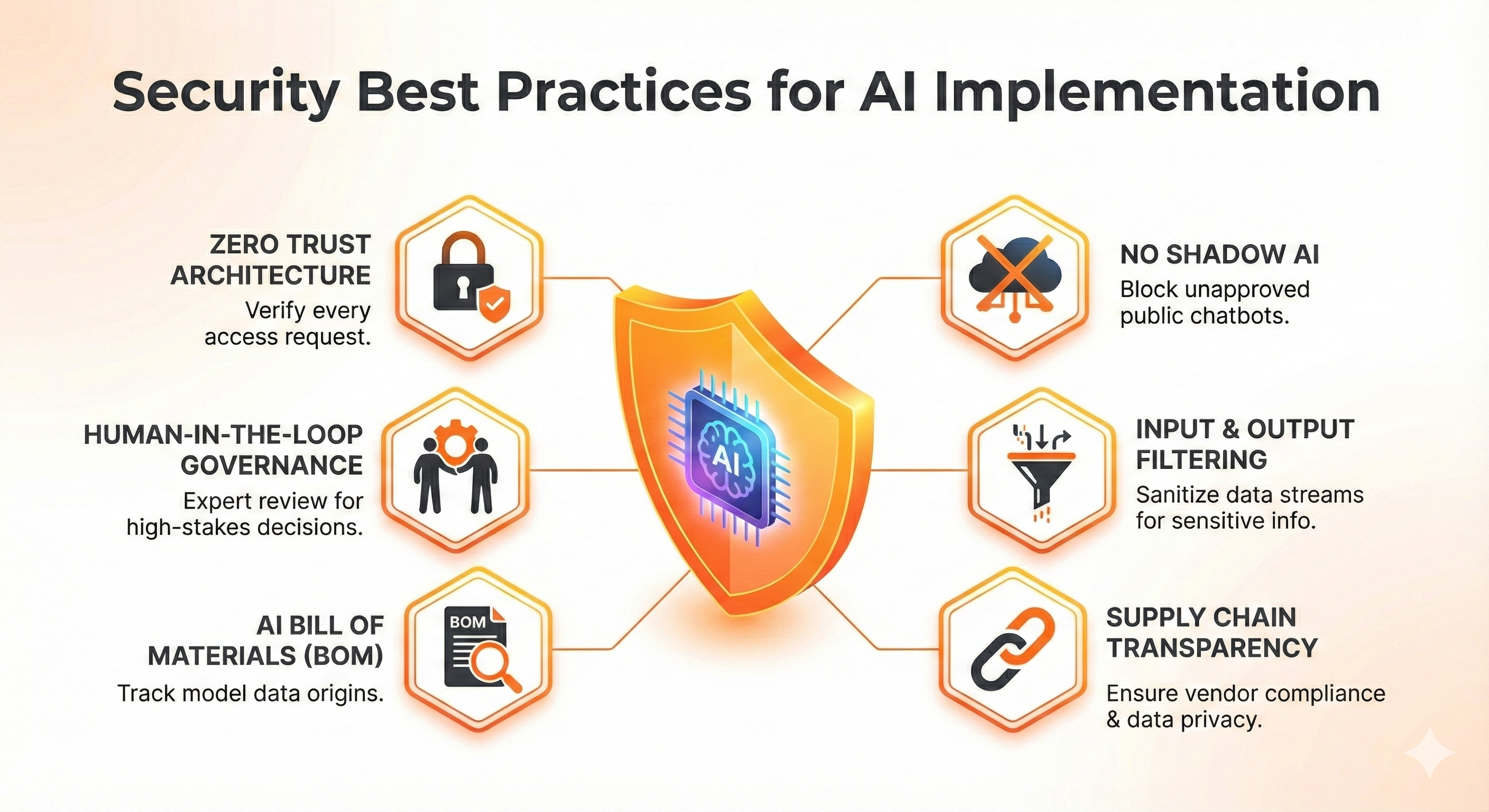
As Artificial Intelligence shifts from a competitive advantage to a business staple, it brings a new breed of digital risks. In 2025, the conversation has moved beyond "Should we use AI?" to "How do we keep our AI from leaking our crown jewels?"
For SMBs, a single data breach through an unvetted AI tool can result in not just financial loss, but a total collapse of customer trust. Security in the age of AI isn't just about firewalls; it's about governance, data integrity, and "Zero Trust" architecture.
Here are the essential security best practices every organization must implement to ensure their AI journey is both transformative and secure.
1. Adopt a "Zero Trust" Architecture for AI Agents
Traditional security relied on the idea that everything inside your network was "safe." In the era of AI assistants and autonomous agents, this model is obsolete.
Zero Trust means your security system assumes every access request—whether from a human or an AI agent—is a potential threat until verified.
- Least-Privilege Access: Your AI assistant should only have access to the specific files and databases it needs to perform its task. If an assistant is only meant to summarize sales notes, it shouldn't have access to your HR payroll folder.
- Continuous Verification: Implement multi-factor authentication (MFA) not just for users, but for the API keys and service accounts that power your AI tools.
2. Guard Against "Shadow AI"
"Shadow AI" occurs when employees use unapproved, public AI tools (like free versions of consumer chatbots) to process sensitive company data.
To combat this, businesses must provide Sanctioned Alternatives. By offering employees a secure, enterprise-grade AI environment—where data is encrypted and not used to train the provider's public models—you eliminate the incentive for them to "go rogue" with public tools.
Pro Tip: Update your Acceptable Use Policy (AUP) to explicitly define which AI tools are approved and what types of data (e.g., PII, trade secrets) are strictly forbidden from public prompts.
3. Implement Input and Output Filtering
AI models are vulnerable to Prompt Injection attacks, where malicious actors use clever phrasing to "jailbreak" the AI and force it to reveal internal system instructions or sensitive data.
You must treat AI inputs like you treat web form entries: Sanitize them.
- Input Scrubbing: Use automated filters to strip sensitive information (like credit card numbers or passwords) before the prompt ever reaches the AI model.
- Output Monitoring: Implement a secondary AI "guardrail" that scans the assistant's response for sensitive internal data or inappropriate content before it is displayed to the user.
4. Ensure Supply Chain Transparency (AI-BOM)
When you implement an AI tool, you aren't just trusting that vendor; you are trusting their entire "supply chain"—the data they used for training, the third-party plugins they use, and the open-source libraries in their code.
Require an AI Bill of Materials (AI-BOM) from your vendors. This document should detail the origin of the models, the data privacy standards of their sub-processors, and their compliance with global regulations like the EU AI Act or GDPR.
5. Establish Human-in-the-Loop (HITL) Governance
AI is a powerful tool, but it is not infallible. High-stakes decisions—such as those involving legal contracts, medical data, or significant financial transactions—should never be fully autonomous.
Establish a Human-in-the-Loop framework where AI-generated outputs are treated as "drafts" that require verification by a domain expert. This doesn't just prevent errors; it provides the "Audit Trail" required for regulatory compliance, showing that a human took ultimate responsibility for the outcome.
The 2025 Security Checklist for SMBs
| Category | Action Item |
|---|---|
| Data Privacy | Enable AES-256 encryption for data at rest and in transit. |
| Identity | Assign unique "Agent IDs" to AI assistants to track their activity. |
| Compliance | Conduct a Data Protection Impact Assessment (DPIA) before deployment. |
| Training | Run monthly "AI Literacy" sessions to teach employees safe prompting. |
Conclusion
Security is not a "set and forget" project; it is the engine that allows your business to innovate safely. By building your AI strategy on a foundation of Zero Trust and rigorous governance, you don't just protect your data—you build a brand that customers can trust in an automated world.
The organizations that win in the AI era won't be those with the most advanced models—they'll be the ones that earn and maintain trust through uncompromising security practices.
Build AI with Confidence
Stage5 is built with security-first architecture. Your data is encrypted, isolated, and never used to train public models. Start building secure AI assistants today.
Start Free BetaNadav Yeheskel
Co-founder & COO, Stage5
Nadav is passionate about democratizing AI and helping businesses automate workflows without code.